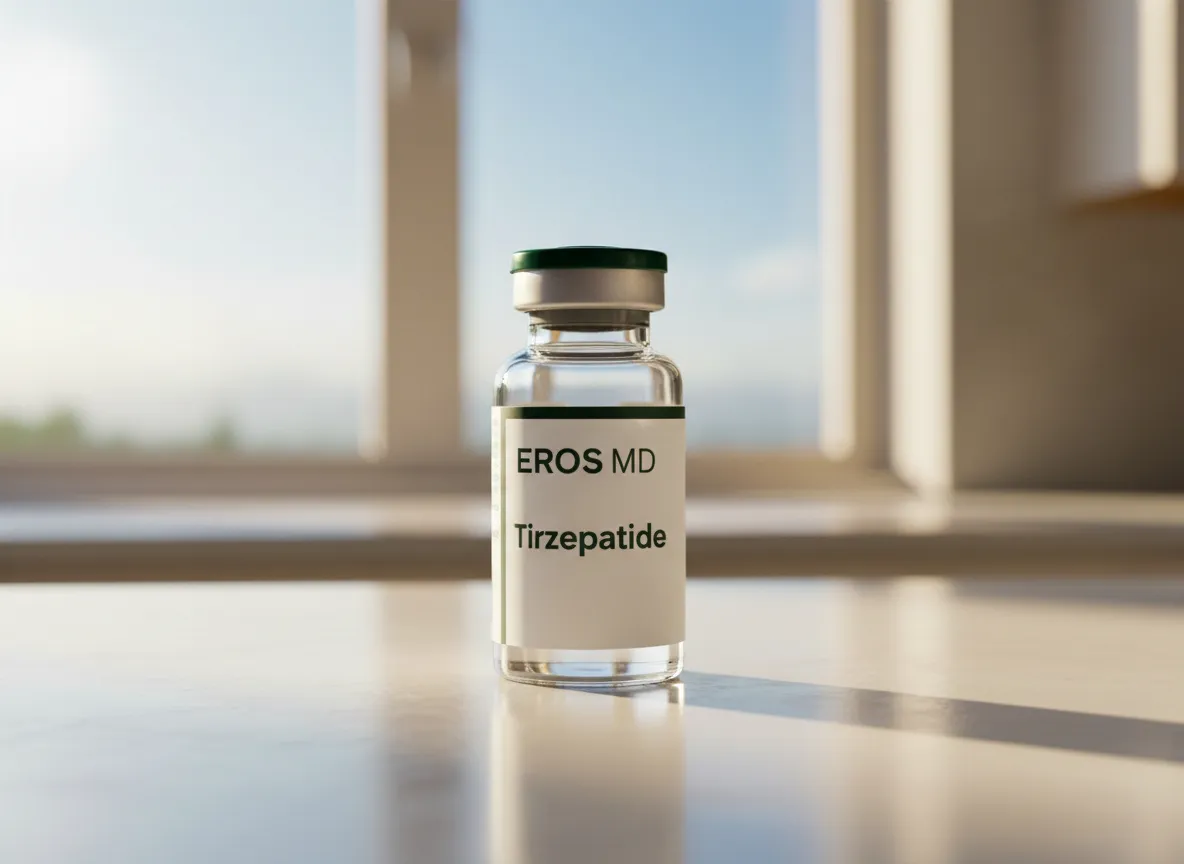
Semaglutide and tirzepatide are the two most prescribed weight loss medications in the United States. Both work through the body's incretin hormone system. Both produce substantially more weight loss than any pharmaceutical option that preceded them. Both require a physician, appropriate dosing, and ongoing monitoring. The question for patients is typically which one fits their specific picture best. The answer is less obvious than headline trial numbers suggest.
The mechanism difference
Semaglutide is a GLP-1 receptor agonist. It mimics GLP-1, a naturally occurring gut hormone that your body releases in response to food. Activating GLP-1 receptors reduces appetite, slows gastric emptying, and improves glucose-dependent insulin secretion. The aggregate effect is a physiological reduction in hunger rather than a willpower-based one.
Tirzepatide is a dual agonist. It activates both the GLP-1 receptor (like semaglutide) and the GIP receptor (a different incretin that works synergistically with GLP-1 on appetite, insulin secretion, and fat cell metabolism). The dual activation produces a somewhat broader metabolic effect and, in clinical trials, somewhat greater weight loss.
What the trials actually show
The STEP trial program for semaglutide 2.4mg weekly demonstrated average weight loss of approximately 14.9 percent of body weight over 68 weeks, compared to 2.4 percent with placebo. The SURMOUNT trial program for tirzepatide 15mg weekly demonstrated average weight loss of up to 22.5 percent over 72 weeks, with roughly half of participants losing 20 percent or more of their body weight at maximum dose.
At face value, tirzepatide produces greater average weight loss. In real-world practice this holds directionally, but individual response varies meaningfully. A specific patient on semaglutide may lose more weight than the same patient would on tirzepatide, and vice versa. Average is a starting point for clinical decision making, not a prescription.
Side-effect profile
Both medications share the gastrointestinal side-effect profile that defines the GLP-1 class: nausea, occasional vomiting, diarrhea, constipation, and early-titration bloating. The profiles are broadly similar in incidence and severity. Slower titration, better hydration, and dietary adjustment during dose escalation reduce side effects for most patients.
Both carry a black box warning for thyroid C-cell tumors based on rodent studies. Both are contraindicated in patients with a personal or family history of medullary thyroid carcinoma or MEN 2 syndrome. Both require physician screening for pancreatitis history, gallbladder issues, and current medications that might interact.
Dosing and titration
Semaglutide titrates over roughly 16 to 20 weeks: 0.25mg for 4 weeks, 0.5mg, 1mg, 1.7mg, and 2.4mg maintenance. Tirzepatide titrates over a similar window but starts at 2.5mg and steps up through 5mg, 7.5mg, 10mg, 12.5mg, to 15mg weekly at maintenance. Not every patient needs to reach maximum dose; many achieve excellent results at intermediate doses with better tolerability.
The right dose is the dose that produces meaningful weight loss with acceptable side effects. A good physician titrates based on your actual response rather than pushing every patient to the maximum dose on principle.
How to actually choose
A few practical decision factors. First, for patients seeking maximum efficacy and able to tolerate the GI profile, tirzepatide has the edge in average outcomes. Second, semaglutide has a longer real-world track record and more published data, which matters to some patients. Third, cost differences vary by insurance, coverage, and compounded versus brand-name product; your physician can walk through options.
Fourth, and perhaps most importantly, the right choice for a specific patient often becomes clear only with actual use. Many patients at Eros MD start on one medication and switch to the other if tolerability or response is not ideal. Switching requires a brief washout and titration restart and is clinically straightforward.
What the platform should provide
Regardless of which medication you start on, the components of a real GLP-1 program are the same: physician evaluation of your metabolic picture, appropriate contraindication screening, titration adjusted to your actual response, side-effect management, and ongoing monitoring. Platforms that hand you a dose and disappear are not practicing obesity medicine. At Eros MD, quarterly check-ins and dose adjustments are part of the plan, regardless of which medication you are on.
Share
About the author
Dr. Dawnmarie Riley, DO
Women's Health Lead · DO
Board-certified OB/GYN and Women's Health Lead at Eros MD. Specializes in hormonal health, perimenopause, menopause, and integrative aesthetics.